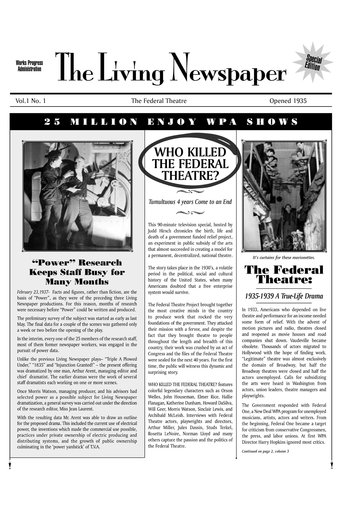
Part journalistic investigation and part performance documentary, "Who Killed The Federal Theater?" tells the story of the Federal Theatre Project within the context of a volatile period in the political, social and cultural history of the United States. The film features interview segments with playwrights, including Arthur Miller, and with actors, directors, designers, and historians. It also incorporates rare archival materials and dramatic sequences, including professionally re-created scenes from Federal Theatre productions that transport viewers back in time to a bygone era in American history and entertainment.
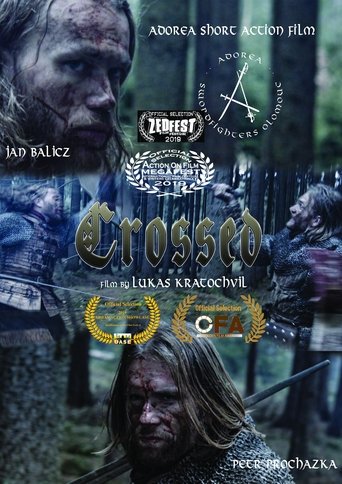
Crossed: sword and shield duel, action short movie, sword fighting, Award winning
The Holy Lance is said to be the weapon with which Roman legionary Longinus pierced Jesus Christ's side after his crucifixion; this documentary explores the history of this captivating artefact.
The leader of a band of mountain bandits defending Naples against the French plays a dual role as a police official. Our romantic hero pivots as well between two women, the sister of a royalist and a lady spy.
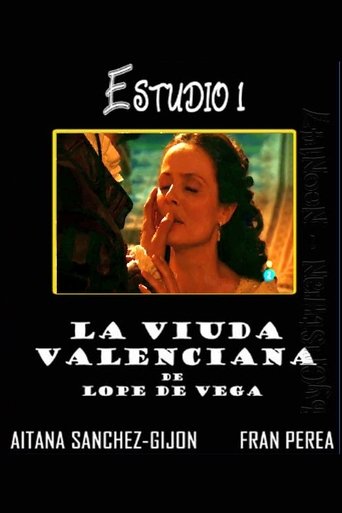
Tv movie adaptation of "The Widow from Valencia",a play written by the Spanish playwright Lope de Vega. It was written circa 1600 as a result of Lope's visit to the city with his new patron, the future Count of Lemos. They were there for the marriage of the King Philip III with Margaret of Austria.
The Suharto regime has been holding power in Indonesia for over 30 years, shutting down democracy time and time again. Highly critical of the regime and unafraid to speak his mind, Wiji Thukul is a poet whose words are often yelled proudly by the crowd during political protests. When riots break out in Jakarta in 1996, he and a few other activists are accused to be responsible. Forced to flee, Wiji escapes to Pontianak in Borneo where he hides for eight months, sometimes living with complete strangers. There, he has to change his identity several times, but continues to write poetry and short stories under a pen name. In the meantime, in Solo, central Java, his wife, Sipon, lives with their two children under constant surveillance. In May 1998, Wiji Thukul is declared missing, a month before Suharto is deposed by his own people.
In this film, four key witnesses, who live in Algeria today, as full-fledged Agerians, show us what this colonization was really like, so "beneficial" that they themselves perceived it as the oppression of one people by another. Three of them, who today would be called "pieds noirs," in other words, those Europeans to whom France, the occupying power, gave the best land, taken from the indigenous populations, work, and exclusive rights, not shared by the entire population, lived rather well compared to the majority of the "natives." The fourth was far from all that and lived in Argentina. Annie Steiner, Felix Colozzi, Pierre Chaulet, and Roberto Muniz explain to us what led them to show solidarity with the struggle of the weak, the humiliated, and to risk their freedom and their lives by committing to liberate Algeria.
Documentary giving the background on all of the major players involved in the planning of the assassination of President Lincoln, including the investigation and aftermath.
Biography of the famous saint of Portuguese origin recalled from the readings of a young boy who one day goes to church with his mother to pray for the return of his father, who is missing in action.
Documentary series in two parts: 1. A people without a voice (80'), 2. A land in mourning (78'). Part 1: A people without a voice: October 88, the Algerian Republic is faltering, the film goes back to the sources of this tragedy and explains how the face to face between the Islamists and those in power began. The interruption of the legislative elections of December 91, followed shortly after the assassination of President Boudiaf in June 92, plunged Algeria into chaos. Part 2: A land in mourning: the cycle of violence that leads to massacres and the economic and geopolitical underside of the war. More than 100,000 deaths, an incredible degree of barbarity, massacres, apparently incomprehensible... Behind the official window of power and its artificial political scene, hides a shadow power.
The War on Disco explores the culture war that erupted over the spectacular rise of disco music. Originating in underground Black and gay clubs, disco had unseated rock as America’s most popular music by the late 1970s. But many diehard rock fans viewed disco, with its repetitive beat and culture that emphasized pleasure, as shallow and superficial. A story that’s about much more than music, The War on Disco explores how the powerful anti-disco backlash revealed a cultural divide that to some seemed to be driven by racism and homophobia. The hostility came to a head on July 12, 1979, when a riot broke out at “Disco Demolition Night” during a baseball game in Chicago.
Love begins to grow between two ninjas from opposing factions. In this forbidden love, the Kunoichi who crossed borders is being pursued by the enemy. The only one who can protect her is another Kunoichi. Here a wager between love and death is about to take place. A Kyoto non-verbal action movie.
Roaming around with her best friend Wabuu, the curious and cheeky raccoon, Pocahontas, the beautiful chieftain daughter discovers a ship with a lot of strangers on the shore. "These White people will bring much woe to our people" predicts the chieftain. And actually, the gold-greedy captain of the ship starts a war on the Indians. Will Pocahontas succeed in preventing the inevitable fight and to save their people?
'THE QUEST: Nepal' is an epic journey to deeper understand and climb the most iconic mountain on earth, Everest, and to unveil the fascinating culture, history and nature of Nepal. From experiencing Mt. Everest like never before to witnessing remarkable rarely seen stories from one of the most unique countries in the world, 'THE QUEST: Nepal' is truly a one-of-a-kind cinematic journey like no other, and one which embodies the incredible human spirit of adventure that lives inside us all!
Director Arnaud de Pallières presents an experimental three-part film designed to stimulate the intellect and inspire reflection on the past. The first part tells the story of the last living Holocaust survivor, who is nearing the end of life and regrets not leaving behind an official record of the horrors he witnessed during the dark years of World War II. Later, a young historian researching a concentration camp in Drancy is shocked to discover that the site now houses an unwelcoming housing project called La Muette (the Silent). The trilogy winds to a close with the story of a ship's captain who recalls the time he ventured up an uncharted river towards an undiscovered civilization.
The story of a small village in Touraine between 1788 and 1789, on the eve of the French Revolution, with its lord, its wealthy peasants, and its poor. The wealthy peasants, expelled from the communal pastures by the count, take him to court. Guillaume Coquard joins the other villagers in drafting the cahiers de doléances (lists of grievances). On the eve of the convocation of the Estates General, the village loses its lawsuit. On the night of August 4, 1789, the deputies vote to abolish privileges. The peasants will be able to buy them back. But the poorest wonder: with what?
This film, in two parts, is considered a cultural work admirably embodied by Alice Sapritch. The TV movie focuses on the period of the late 16th century in France, ravaged by religious wars, and highlights the efforts of Catherine de Medici to defend the throne of her sons and maintain the unity of the kingdom. The role of Catherine de Medici in this TV movie is an interpretation that gives more humanity to this historical figure often presented in a negative light in history.
In this short film directed in the style of Andrei Tarkovsky, eternity and the downfall of the Soviet empire are explored in a deeply symbolic and poetic way. The film follows a protagonist as they traverse a desolate landscape, reflecting on the transient nature of life and the inevitability of death. Through a series of dreamlike sequences, the audience is presented with a powerful meditation on the idea of eternity, and how it can be seen in the rise and fall of empires. The film culminates in a powerful scene of the protagonist standing atop a hill, looking out at the ruins of the Soviet empire, and contemplating the eternal cycle of life and death.
Using original footage, looks at the various attempts to climb the world's loftiest peak, in particular the successful 1953 expedition, when, on 29 May, Edmund Hillary and Tenzing Norgay raised the Union Jack on the summit of Everest.
Émilie Jolie follows a young girl who, frightened by the night, opens a picture book to find comfort. She realizes she can interact with the characters, who are all waiting for her to help them find happiness.
Activate your FREE Account!
You must create an account to continue watching